 how-to
9 Clauses Your Outdoor Living Space Construction Contract Needs
Last Updated: November 2, 2026
Quick Summary
An outdoor living space construction contract is the written agreement that defines what will be built, who builds it, how much it costs, when it finishes, and what happens when something changes. Every outdoor living space construction contract should cover nine clauses, including scope of work, payment terms, change orders, timeline, and warranty, before you sign.
- Verify the contractor's legal business name matches their license and insurance certificate.
- Require lien waivers from subcontractors as payments are made and an indemnification clause against liens.
- Tie every payment to a verifiable milestone and ask what percentage is held as retainage.
- No additional work should proceed without a signed change order listing added cost and schedule impact.
- The workmanship warranty should be a separate written clause stating duration and what it covers.
Table of Contents
- Why the Outdoor Living Contract Decides Your Project
- The Outdoor Construction Contract Checklist
- Parties, Property, and Project Description
- Insurance, Licensing, and Lien Protections
- What Belongs in the Construction Contract Scope of Work
- Payment Schedules, Deposits, and the Construction Change Order Process
- How the Outdoor Living Space Project Timeline Is Set
- Materials, Finishes, and Workmanship Warranty Clauses
- Permits, Building Codes, and Weather or Delay Provisions
- Before You Sign: Questions to Ask a Contractor
- Frequently Asked Questions
Why the Outdoor Living Contract Decides Your Project
An outdoor living space construction contract is the written agreement that defines what will be built, who builds it, how much it costs, when it finishes, and what happens when something changes, which is why every outdoor living space construction contract deserves a careful read before you sign.
Many homeowners spend weeks choosing finishes and features, then sign a short proposal without reading it closely. That is backwards. The contract is where a project succeeds or fails, long before the first footing is poured.
At Lush Design Build LLC, we work with homeowners across Carmel, Fishers, and Zionsville on custom outdoor structures and home improvement projects, and a clear written agreement makes a meaningful difference for every project. Below, we break down the nine clauses every contract needs, plus the questions to ask before you sign anything.
The Outdoor Construction Contract Checklist
A complete outdoor construction contract checklist covers nine areas: parties and property details, project description, insurance and licensing, scope of work, payment terms, change order process, timeline, materials and warranty, and permits and delay provisions. Miss any one of these and you leave yourself exposed.
Here is the full picture at a glance:
| Contract Element | What It Protects | What to Verify |
|---|---|---|
| Parties and property | Correct legal entity and address | Exact legal name, license number, property description |
| Insurance and liens | Your home from claims and unpaid bills | Certificate of insurance, lien waiver terms |
| Scope of work | What is and isn't included | Line-by-line specifications, exclusions listed |
| Payment schedule | Your cash flow and use | Deposit size, milestone payments, retainage |
| Change orders | Cost control | Written approval required before work proceeds |
| Timeline | Schedule expectations | Start date, milestones, weather allowances |
| Materials and warranty | Quality and recourse | Brand names, model numbers, written warranty |
| Permits and delays | Code compliance | Who pulls permits, delay definitions |
| Dispute terms | Resolution path | Mediation clause, notice requirements |
Print this table and bring it to your first design consultation to help spot a thin proposal.
Parties, Property, and Project Description
The first page of any construction contract should identify exactly who is building and exactly what property is covered. Sounds obvious. It is also where the most avoidable problems start.
Check that the contractor's legal business name matches the name on their license and insurance certificate. A proposal signed by "GreenScape Pros" when the licensed entity is "GreenScape Pros LLC" creates ambiguity about who is actually responsible. The property description should include the street address and a clear reference to the work area, whether that is a rear patio, a pool house footprint, or a full outdoor kitchen zone.
The project description is a summary, not the detailed scope. Think of it as the headline: "Covered pavilion with outdoor kitchen and fireplace, approximately 400 square feet." The specifics belong in the scope of work section. If the description and the scope conflict, the scope should govern, and the contract should say so.
Insurance, Licensing, and Lien Protections
Ask for a certificate of insurance before signing, and confirm three coverages: general liability, workers' compensation, and commercial auto if vehicles come on site. A contractor without workers' comp coverage can leave you exposed if a crew member is injured on your property.
Licensing requirements vary by state and municipality, so verify the contractor's credentials with the authority that issues them rather than taking a proposal's word for it. The U.S. Small Business Administration's guide to hiring contractors offers a practical framework for checking licenses and insurance before work begins.
Lien protections matter just as much. A mechanics lien lets unpaid subcontractors or suppliers file a claim against your property, even if you paid the general contractor in full.
What Belongs in the Construction Contract Scope of Work
The construction contract scope of work is the detailed, line-by-line description of everything being built, including materials, dimensions, finishes, and what is explicitly excluded. This is the section that prevents the "that wasn't included" conversation six weeks into construction.
A strong scope of work reads like a specification sheet:
- Structure: footing depth and type, framing materials, beam and joist sizing
- Surfaces: decking brand and product line, paver manufacturer and pattern, stone veneer selection
- Features: fireplace model and fuel type, grill brand and model number, built-in storage dimensions
- Electrical and utilities: lighting locations, outlet count, gas line routing, water supply for sinks
- Finishes: stain or sealant product, countertop material and edge profile
- Exclusions: landscaping repair, irrigation relocation, furniture, appliances not listed
The exclusions list is not a weakness. It is clarity. A contractor who lists what they are not doing is being honest about the boundaries, and you can price those items separately if you want them.
Watch out: a scope that says "premium composite decking" without a brand and product line gives the builder room to substitute a lower grade. Insist on manufacturer names and model numbers for every visible material.
Payment Schedules, Deposits, and the Construction Change Order Process
A fair payment schedule ties money to completed milestones, not to the calendar. The construction change order process is the mechanism that keeps costs from drifting, and it only works if the contract requires written approval before any extra work begins.
Deposit sizes vary by contractor and project scope, and larger custom builds often justify larger upfront commitments for material ordering. What matters is that every payment is tied to something you can verify: footings inspected, framing complete, decking installed, final walkthrough passed. Ask what percentage is held as retainage until punch list completion.
Change orders deserve their own paragraph in the contract. The clause should state that no additional work proceeds without a signed change order listing the added cost and any schedule impact. Verbal approvals are how budgets collapse. If your builder is willing to make a small adjustment on a handshake, ask them to write it down anyway.
How the Outdoor Living Space Project Timeline Is Set
An outdoor living space project timeline should list a start date, major milestones, and a substantial completion date, with a defined weather allowance built in. Outdoor construction is weather-dependent, and a contract that ignores that reality sets everyone up for conflict.
Ask the contractor to break the schedule into phases: design finalization, permit review, site prep and excavation, foundation and framing, utilities rough-in, finishes, and final inspection. Each phase should carry a target date or duration.
The contract should also define what counts as a delay and what happens when one occurs. Distinguish between weather days, permit review time outside the contractor's control, and contractor-caused delays. A well-written clause states how schedule extensions are documented and communicated. If a builder cannot explain their scheduling assumptions in plain language, that is a signal about how the project will be managed.
Materials, Finishes, and Workmanship Warranty Clauses
Every material specified in the scope should appear in the contract with enough detail to be enforceable, and the workmanship warranty should be a separate, written clause with a stated duration and what it covers.
Material specifications protect you from substitutions. "Cedar decking" is a category. "Western red cedar, 5/4 by 6 inch, grade 2 or better" is a specification. The more precise the contract, the less room for a mid-project swap.
For material durability comparisons before you finalize selections, consider reviewing options with your design team during the planning phase.
The workmanship warranty is where many contracts go quiet. It should state, in writing, how long the contractor stands behind their installation, what is covered versus what falls under the manufacturer's product warranty, and how claims are submitted. Product warranties and labor warranties are different things.
Permits, Building Codes, and Weather or Delay Provisions
The contract should state clearly who is responsible for pulling permits, who pays permit fees, and that all work will comply with applicable building codes. In most residential projects the contractor handles permitting, but the contract must say so.
Permits and inspections take time, and that time belongs in the schedule. A contract that promises a completion date without accounting for permit review is promising something the builder cannot control. Ask how permit review time is handled in the timeline and who schedules inspections.
Weather provisions should define what counts as a weather delay and how those days are tracked. Rain, frozen ground, and extreme heat all affect outdoor construction schedules. The clause should require the contractor to notify you when weather delays occur and to provide a revised schedule.
Before You Sign: Questions to Ask a Contractor
Before signing, ask direct questions about licensing, insurance, subcontractors, payment terms, change orders, warranty coverage, and the dispute resolution process, and get the answers in writing. Readers comparing bids can also review how to choose custom patio builders in Hamilton.
Here is the list we would bring to any meeting:
- What is your license number, and which entity holds it?
- Can you provide a current certificate of insurance for general liability and workers' compensation?
- Which portions of this project will be subcontracted, and are those subcontractors insured?
- What is the deposit, and what milestones trigger each subsequent payment?
- How do change orders get approved, and who signs them?
- What does your workmanship warranty cover, and for how long?
- Who pulls the permits, and how is permit review time reflected in the schedule?
- How do you handle weather delays and schedule updates?
- What is the dispute resolution process if we disagree?
- Can I see the full scope of work and exclusions before I sign?
To understand how a design-build agreement consolidates design and construction under one contract, learn more about our design-build process at lushdesignbuild.net before you reach out.
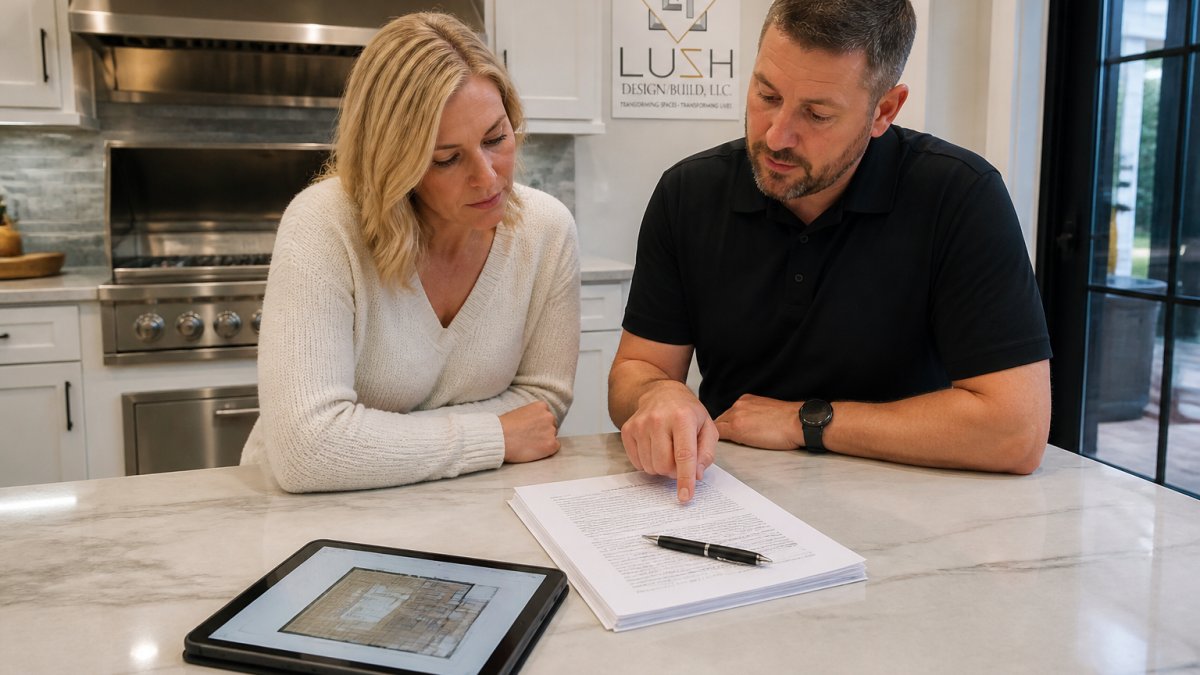
A final note on reading the whole document. You can also read our About Us page to verify our background and approach.
The contract is the foundation everything else sits on, and a vague one can cost you far more than any material upgrade.
Frequently Asked Questions
What should an outdoor living space construction contract include?
Every outdoor living contract should name the parties and property, describe the project in detail, list materials and finishes, set a payment schedule tied to milestones, and explain the change order process. It should also cover the project timeline, permit responsibilities, insurance and lien protections, warranty terms, and how delays or disputes are handled. If a clause is missing, ask for it in writing before you sign.
What is the difference between a construction contract and a project proposal?
A proposal is a sales document. It outlines ideas, rough pricing, and design direction, and it is not binding. A construction contract is the legal agreement that governs the build. It locks in the construction contract scope of work, payment terms, schedule, and warranty obligations. Treat the proposal as the starting point of the conversation and the contract as the document that controls the job.
How are design changes handled in an outdoor construction contract?
Changes should run through a written construction change order process. You request the change, the contractor prices the cost and schedule impact, and both parties sign before work proceeds. A good contract states that no verbal changes are binding and that work outside the scope of work is not performed until the change order is approved. This keeps the project budget and timeline from drifting.
What permits should be addressed in an outdoor living space contract?
The contract should state who pulls permits, who pays permit fees, and who schedules inspections. Decks, covered structures, electrical work, and gas lines for outdoor kitchens usually require permits and inspections. Confirm the contractor carries the licensing and insurance required locally, and ask for lien waivers from subcontractors as work is completed so your property stays protected.