 How-to
How to Choose Weather-Resistant Luxury Outdoor Furniture
Last Updated: November 12, 2026
Quick Summary
Choose weather-resistant luxury outdoor furniture by matching materials to your actual exposure, such as sun, rain, humidity, and freeze-thaw cycles, and to how much maintenance you want to do. Teak, powder-coated aluminum, marine-grade stainless steel, all-weather wicker, and HDPE lumber are the strongest performers, while cushion fabric, foam, and drainage design determine how well soft seating survives wet seasons.
- Map each seating area's exposure before comparing materials, since covered porches and open patios face different stresses.
- Teak turns silver-gray over time, so oil it on a schedule if you want the original golden tone.
- Specify marine-grade stainless steel for humid or pool-adjacent areas, because lower grades can pit or show rust streaks.
- Choose breathable, water-repellent cushion fabric over quick-drying foam rather than a fully waterproof shell that traps moisture.
- Freeze-thaw cycles and snow load break furniture in a four-season climate, so check drainage holes, sealed end grain, and snow-shedding surfaces.
Table of Contents
- Why Climate Should Drive Your Outdoor Furniture Choice
- Comparing Outdoor Furniture Materials for Durability and Upkeep
- Why Powder-Coated Aluminum Patio Furniture Holds Up Well Outdoors
- Best Outdoor Furniture Material for Rain and Humidity
- Choosing Cushions and Fabrics, Including Sunbrella Outdoor Furniture
- Construction Details That Signal Quality, Wind, and Drainage Performance
- Planning Your Outdoor Furniture Purchase with Lush Design Build
- Frequently Asked Questions
Why Climate Should Drive Your Outdoor Furniture Choice
Choosing weather-resistant luxury outdoor furniture starts with your climate, not your catalog.
Start by mapping exposure. A covered screened porch faces very different stresses than an open patio taking full afternoon sun and driving rain. Furniture under a pergola or roof still deals with humidity, temperature swings, and wind-driven moisture, while pieces on an exposed deck or near a pool face sun, chlorine, and standing water.
Next, consider storage. Some owners want pieces that stay out all year with minimal care; others will move cushions indoors or cover frames in winter. Both approaches work but lead to different material choices and budgets, so being honest about your maintenance habits saves money and disappointment later.
Comparing Outdoor Furniture Materials for Durability and Upkeep
Material choice drives most of the long-term outcome. Each option has real strengths and tradeoffs, so compare them against your exposure and maintenance preferences rather than appearance alone.
| Material | Weather Resistance | Maintenance | Best Fit |
|---|---|---|---|
| Teak | Very high; naturally oily wood resists moisture | Low to moderate; can silver or be oiled | Covered or open patios, premium look |
| Powder-coated aluminum | High; resists rust and corrosion | Low; wipe clean | Most climates, lightweight pieces |
| Stainless steel | High; excellent corrosion resistance | Low; occasional polishing | Modern designs, pool areas |
| All-weather wicker (synthetic) | High; UV-stabilized resin | Low; hose clean | Lounge sets, traditional styles |
| HDPE lumber | Very high; won't rot or splinter | Very low | Durable frames and benches |
Teak, Stainless Steel, and Other Metal Options
Teak is widely regarded as one of the more durable outdoor woods, and its natural oils help it shed water. Over time, untreated teak turns silver-gray, which many owners find attractive. If you prefer the original golden tone, plan to clean and oil it on a regular schedule.
Stainless steel offers strong corrosion resistance and a clean, contemporary look. Grade matters here. Marine-grade stainless holds up far better in humid or pool-adjacent settings than lower grades, which can pit or show rust streaks. Ask about the grade before you buy.
Wrought iron is heavier and beautiful in traditional settings, but it needs a quality powder coat or sealant to resist rust. Inspect the finish carefully, especially at welds and joints.
All-Weather Wicker and HDPE Lumber
All-weather wicker is typically woven from UV-stabilized synthetic resin over an aluminum frame. It handles sun and rain well and resists the cracking that affects natural rattan. Quality varies widely, so check weave tightness, frame construction, and UV rating.
HDPE lumber is a dense recycled plastic used for frames, slats, and benches. It won't rot, splinter, or need staining, making it a strong low-maintenance choice. It is heavier and more utilitarian in look, so it suits some designs better than others.
Why Powder-Coated Aluminum Patio Furniture Holds Up Well Outdoors
Powder-coated aluminum patio furniture is one of the most practical choices for many Indiana homes. Aluminum does not rust the way steel does, and a properly applied powder coat resists chipping and fading. The frames stay light enough to rearrange seating for a gathering.
Quality still matters. Look for even coating with no thin spots, especially at joints and edges where moisture collects, and ask whether the finish is UV-resistant, since cheaper coatings can chalk or fade in strong sun.
Powder-coated aluminum pairs well with other materials. Many owners use it for dining and lounge frames, then add performance cushions for comfort and sun resistance.
Best Outdoor Furniture Material for Rain and Humidity
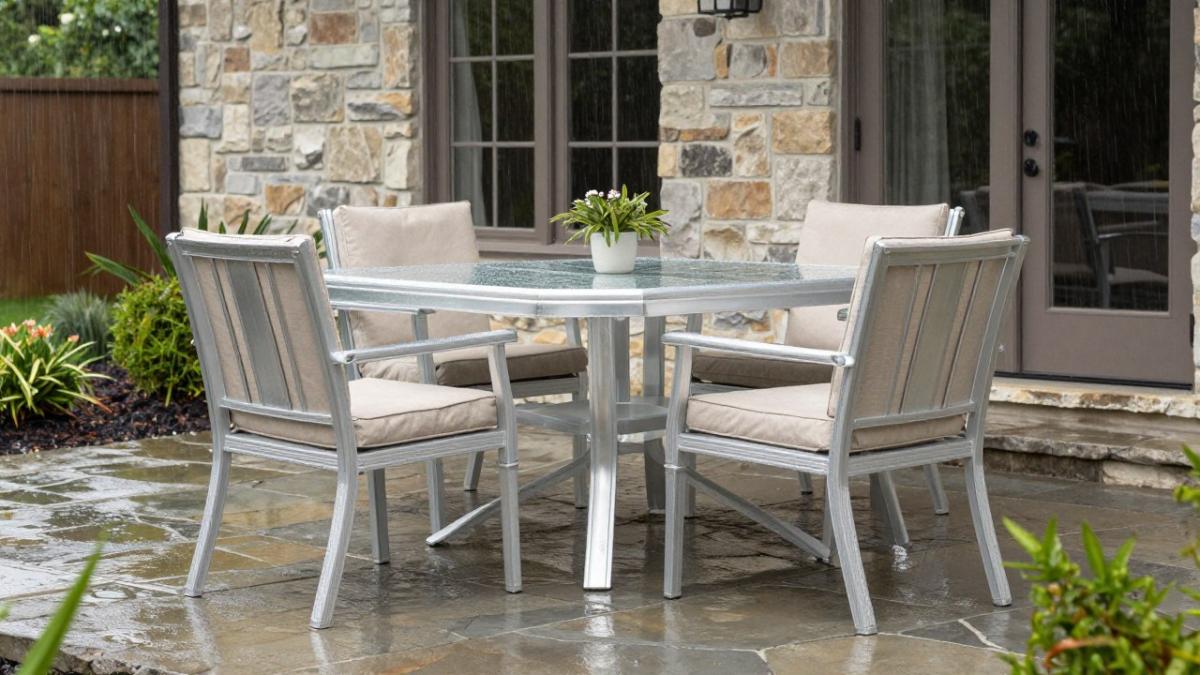
Rain and humidity test furniture differently than sun does. Moisture drives mildew, swelling, rust, and rot, so the best performers have low water absorption, sealed end grain, and drainage paths that let water leave the piece instead of pooling inside it.
The mechanism matters more than the label. Wood swells when end grain absorbs water and shrinks as it dries, and that cycle opens checks and joints.
Drainage around the furniture matters as much as the material. Pieces sitting in standing water or on moisture-trapping surfaces age faster. Elevated feet, slatted seats, and quick-drying cushion fabrics all help, and a covered patio reduces how much rain reaches the furniture.
Humidity alone is less damaging than repeated wetting and drying; furniture that stays damp for long periods is the real concern.
Freeze-Thaw, Snow, and Wind: The Conditions Most Buying Guides Skip
Most material comparisons stop at sun and rain, but freeze-thaw cycles, snow load, and wind are what actually break furniture in a four-season climate.
Watch out: furniture left out through winter with cushions in place can hold snowmelt against the frame for weeks, and the freeze-thaw cycle will do more damage in one season than a decade of summer sun.
For snow, the practical questions are whether the frame is rated to carry a load and whether the surface sheds it; flat tabletops, wide arms, and solid seats collect snow, while slatted and pitched surfaces shed it.
Matching Material to Exposure
A simple way to decide is to map each seating area against the stresses it actually sees. A covered porch deals with humidity and temperature swings but little direct rain; an open patio takes sun, driving rain, and freeze-thaw; a pool deck adds chlorine and splash; a windy, exposed deck adds load and movement.
This is also where the design of the space and the choice of furniture should be settled together. Roof overhangs, pergola spacing, drainage slope, and surface materials all change how much weather reaches the furniture, and getting those right at the design stage is cheaper than replacing furniture later. If you are planning a larger outdoor project, contact Lush Design Build LLC to talk through exposure, drainage, and design goals before you commit to a material.
Choosing Cushions and Fabrics, Including Sunbrella Outdoor Furniture
Cushions are often the first part of outdoor furniture to fail, and the reason is usually specification rather than brand. Two cushions can carry the same fabric name and behave completely differently because of the fiber, the foam, the seams, and the way water leaves the piece. Understanding those specifications is how you tell a premium cushion from a lookalike.
Start with the fiber. Solution-dyed acrylic fabrics, such as those sold under the Sunbrella name, are colored before the fiber is spun rather than surface-dyed afterward, which generally helps color hold up better under UV exposure. Always confirm the specific product, construction, and warranty with the manufacturer or your furniture supplier.
Reading Fabric Specifications
The label tells you more than the brand name. Look for fiber content, UV or lightfastness rating, and whether the fabric is water-repellent or waterproof. Water-repellent fabric beads water and lets it run off; waterproof fabric blocks it entirely, which sounds better but can trap moisture inside the cushion if water enters through seams. For most outdoor seating, a breathable, water-repellent fabric over quick-drying foam performs better than a fully waterproof shell that seals moisture in.
Seam construction is the quiet detail that separates grades. Stitched seams with proper thread and reinforced stress points hold up; glued or lightly stitched seams open under sun and repeated wetting. Zippers, ties, and piping should be corrosion-resistant and finished so they do not wick water into the cushion core.
Foam, Drainage, and Mildew Prevention
The foam inside the cushion decides how it feels after a rainstorm. Quick-drying, open-cell foam lets water pass through and air circulate; dense closed-cell foam can hold water and break down.
Mildew prevention is mostly about airflow and drying. Cushions that sit flat on a solid seat, or that are stored damp, grow mildew regardless of fabric quality.
Watch out: a premium fabric over cheap foam is still a cheap cushion, and a waterproof cover over foam that never dries can trap moisture and smell worse than a breathable fabric that dries out.
Performance fabric is worth the premium for furniture that stays outdoors year-round. To see how we approach these details in custom outdoor living spaces, review our services.
Construction Details That Signal Quality, Wind, and Drainage Performance
Construction details reveal more about durability than marketing copy does. Check the joints first: welded or properly fastened joints with no visible gaps resist loosening over time, and screws and fasteners should be corrosion-resistant, ideally stainless steel or coated hardware.
Weight and base design affect wind performance. Heavier frames and wider bases stay put in gusts, while very light pieces can tip or slide across a patio.
Drainage features are easy to overlook. Look for drainage holes in cushion bases, slatted seats that let water pass through, and frames that do not trap water in cavities.
Finally, consider how the furniture interacts with the surrounding space. Pieces that sit on a properly graded, well-drained surface last longer than those on pooling ground. Good outdoor design accounts for water, wind, and sun together.
Planning Your Outdoor Furniture Purchase with Lush Design Build
Furniture works best when it is planned as part of the whole outdoor space. Layout, shade, drainage, lighting, and the structure around the seating all affect how long the pieces last and how often you use them. Lush Design Build LLC works with homeowners on custom outdoor living spaces, including decks, patios, pergolas, pavilions, and outdoor kitchens, so furniture choices can fit the architecture from the start.
Before you buy, make a simple plan. Note the exposure of each seating area, the storage options you can realistically use, and the maintenance you are willing to do. Then compare materials against those answers and inspect construction details in person when possible.
If you are planning a larger outdoor project, contact Lush Design Build LLC to talk through your space, climate exposure, and design goals. For additional guidance on protecting furniture, explore shade solutions for outdoor kitchens and seating areas, and if standing water is a concern, read about fixing backyard drainage problems. For decking and surface materials that hold up in our climate, see our comparison of durable outdoor deck materials.
Frequently Asked Questions
What type of outdoor furniture is the most durable and long-lasting?
Durability depends on how the furniture is built and where it sits. Teak and powder-coated aluminum are commonly chosen for outdoor furniture because they handle weather well. Teak can be left to weather to silver. Powder-coated aluminum resists rust and does not need sealing. Both perform best when cushions are stored or covered during long off-seasons and when the frame is inspected at least once a year for loose hardware.
What type of patio furniture is the most weather resistant?
Powder-coated aluminum, stainless steel, and HDPE lumber are commonly used materials that handle rain, humidity, and sun well. Aluminum is lightweight and rust-resistant, HDPE does not rot, warp, or need staining, and teak tolerates moisture when it is properly oiled or allowed to silver. Covered patios and screened porches extend the life of any material because they reduce direct water and UV exposure.
Does powder-coated aluminum outdoor furniture rust?
Powder-coated aluminum does not rust in normal conditions because the aluminum itself does not rust and the powder coating seals the surface. Rust can appear only if the coating is chipped or scratched and the exposed metal is left in contact with salt, standing water, or abrasive dirt. Touch up chips promptly with a matching coating to keep the frame protected.
Is Sunbrella outdoor furniture suitable for outdoor furniture cushions?
Sunbrella outdoor fabric is a solution-dyed acrylic, meaning the color runs through the fibers rather than sitting on the surface, which generally helps it hold up under sun exposure. Look for solution-dyed construction, a warranty on the fabric, and a removable, washable cover on any cushion you plan to keep outdoors year-round.