 ultimate-guide
Which Patio Paving Is Best for a Modern Luxury Home?
Last Updated: November 4, 2026
Quick Summary
Porcelain pavers are the strongest choice for modern luxury patio paving, offering uniform color, tight 2-3 mm joints, and minimal upkeep, provided they sit on a flawless, well-drained sub-base. Natural stone such as bluestone or granite delivers character and depth, but demands sealing and more maintenance.
- Porcelain resists staining, fading, and moisture absorption because it is fired at high temperature.
- Large-format concrete slabs reduce visible joints but require a base built to prevent settling.
- Water expands roughly 9 percent when it freezes, so absorption rate and base drainage matter most.
- Specify thermal, sandblasted, or cleft finishes around pool decks to keep traction when wet.
- Set conduit, gas lines, and transformer locations before paving goes down, not after.
Table of Contents
- What Defines Modern Patio Paving for High-End Homes
- Porcelain vs Natural Stone Pavers: How the Two Compare
- Large-Format Concrete Slabs and the Minimalist Look
- Durability, Slip-Resistance, and Maintenance by Material
- Luxury Outdoor Hardscape Design for Contemporary Architecture
- Long-Term Value, Sustainability, and Smart Outdoor Integration
- Choosing a Contractor for High-End Patio Paving
- Planning Your Patio Paving Project With Lush Design Build
- Frequently Asked Questions
What Defines Modern Patio Paving for High-End Homes
Modern patio paving for high-end homes is a specification decision, not a color swatch.
Below, we break down how porcelain, natural stone, and large-format concrete actually perform, what each costs you in maintenance, and where the design trends that photograph well fall apart in practice.
The first thing most homeowners get wrong: they shop for a surface before they've decided how the space will drain and how the house will meet the ground.
Porcelain vs Natural Stone Pavers: How the Two Compare
Porcelain and natural stone are the two dominant choices for high-end patio paving, and the trade-off comes down to consistency versus character. Porcelain gives you uniform color, tight joints, and minimal upkeep. Natural stone gives you depth, variation, and a surface that ages into the landscape.
Here's how they stack up on the criteria that actually drive decisions:
| Criterion | Porcelain Pavers | Natural Stone |
|---|---|---|
| Color consistency | Uniform batch to batch | Varies by slab and lot |
| Joint width | Tight, 2-3 mm possible | Wider, mortar or sand joints |
| Maintenance | Rinse and occasional deep clean | Sealing and re-sanding |
| Slip-resistance | Textured finishes available | Depends on finish and stone |
| Freeze-thaw behavior | Very stable when installed right | Good, but porous stones need care |
| Best for | Clean, minimalist facades | Warm, textured, one-of-a-kind looks |
Porcelain Pavers: Tight Joints, Consistent Color, Low Upkeep
Porcelain pavers are generally regarded as a low-maintenance high-end surface. Because they're fired at high temperature, they resist staining, fading, and moisture absorption. The tight joints are the design payoff: you get clean lines that read as a single plane rather than a grid of individual stones.
The catch is that porcelain demands a flawless sub-base. It's thin and rigid, so any deflection telegraphs straight to the surface. In practice, this means a properly compacted, well-drained base is non-negotiable.
Natural Stone: Bluestone, Travertine, Slate, and Granite
Natural stone is where a patio gains texture and permanence. Bluestone brings a cool, dense surface that pairs beautifully with contemporary architecture. Travertine offers warmth and a tactile finish underfoot. Slate delivers dramatic color shifts and a fine-grained texture. Granite is the hardest of the group and holds up to heavy use.
Each stone behaves differently with water and freeze-thaw cycles, so the finish matters as much as the species. A honed or thermal finish keeps slip-resistance reasonable while preserving the look.
Large-Format Concrete Slabs and the Minimalist Look
Large-format concrete slabs deliver the minimalist aesthetic with fewer visible joints than traditional pavers. Fewer joints mean fewer lines competing with the architecture, which is exactly what a modern facade wants. The surface can be finished in matte, sandblasted, or polished textures to match the home.
The trade-off is weight and installation tolerance. Big slabs require careful handling and a base built to carry them without settling. Where they're done well, they read as a poured plane. Where they're done poorly, the joints crack and the effect collapses.
Durability, Slip-Resistance, and Maintenance by Material
Durability and slip-resistance are where material marketing and real-world performance diverge. Every premium material can last decades, but only if it's specified for the climate and maintained on a realistic schedule. The sections below translate manufacturer claims into the mechanisms that actually determine how a surface behaves after five, ten, and twenty winters.
Freeze-Thaw Behavior: The Mechanism That Breaks Patios
Water expands roughly 9 percent when it freezes (Water Density). In a patio, that expansion happens inside the paver's pores, the bedding layer, and the joints. A material with low absorption and a dense body pushes water out before it can freeze; a porous material holds it, and repeated cycles spall the surface and heave the base. This is why the same bluestone that performs for decades in a mild climate can flake in a colder one if it's set on an underdrained base.
The practical takeaway: absorption rate and base drainage matter more than the marketing name on the box. Porcelain and granite sit at the low-absorption end; travertine and some slates sit higher and need sealing and a more aggressive drainage detail.
Slip-Resistance: What the Ratings Actually Mean
Slip-resistance is measured on a recognized scale, and the number matters most around pool decks, steps, and any surface that stays wet. Slip-resistance is typically reported as a coefficient of friction, and manufacturers publish this data for tile and paver products.
Finish is the lever you control. A polished or honed surface reads beautifully dry and turns hazardous wet. Thermal, sandblasted, bush-hammered, and cleft finishes keep the look while restoring traction. For a pool deck, specify the finish for the wet condition first and the aesthetic second.
Maintenance Cadence by Material
Maintenance is not a single task; it's a schedule. The table below summarizes what each material realistically demands.
| Material | Routine care | Periodic work | Watch for |
|---|---|---|---|
| Porcelain | Rinse, occasional pH-neutral deep clean | Re-sand or re-grout joints as they weather | Base deflection telegraphing through thin pavers |
| Bluestone | Sweep, rinse | Seal every few years; keep joints filled | Spalling on lower-grade stock; efflorescence |
| Granite | Sweep, rinse | Seal periodically | Slipperiness when polished and wet |
| Travertine | Sweep, rinse | Seal and refresh finish over time | Porosity, staining, freeze-thaw damage |
| Slate | Sweep, rinse | Keep joints filled; spot-seal | Flaking on lower-grade cleft stock |
| Large-format concrete | Sweep, rinse | Seal to resist staining | Joint cracking if the base settles |
Watch out: sealing a damp or newly installed surface traps moisture and can cause hazing or efflorescence. Confirm the material's cure and dryness window with the installer before any sealer goes down.
Because paving performance depends on water management, it's worth planning drainage before you choose a finish, and our guide on designing a backyard that drains correctly walks through grading, swales, and French drains.
Luxury Outdoor Hardscape Design for Contemporary Architecture
Luxury outdoor hardscape design is the discipline of making the patio feel like an extension of the house rather than an addition to the yard.
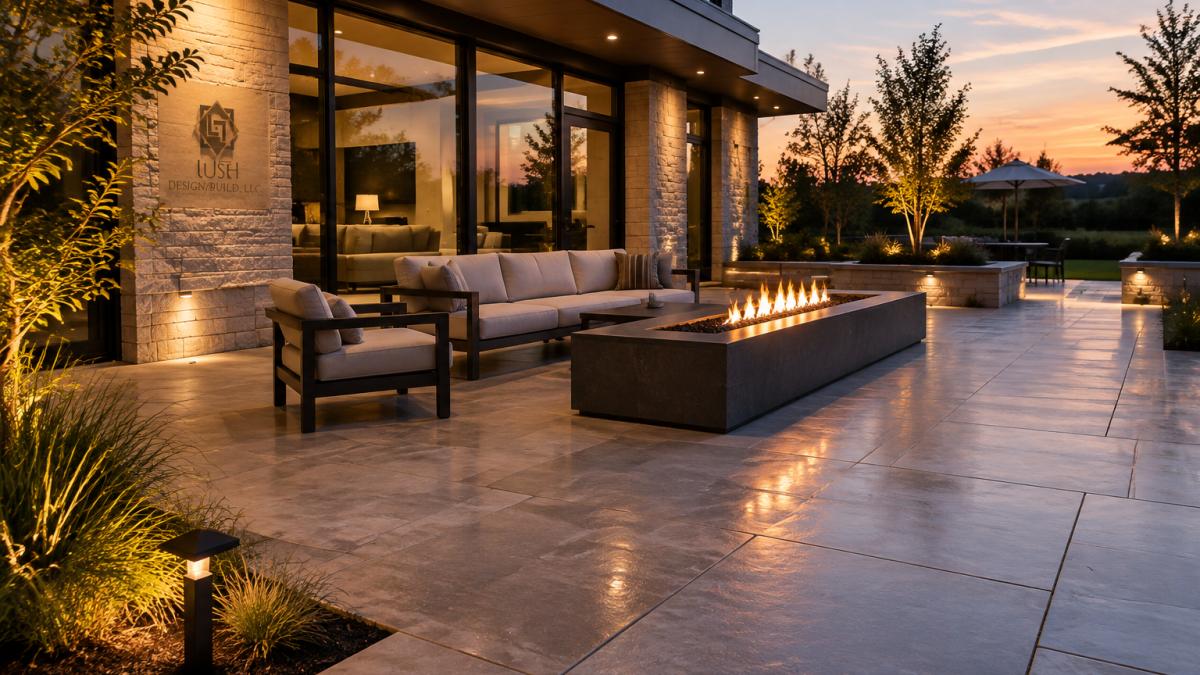
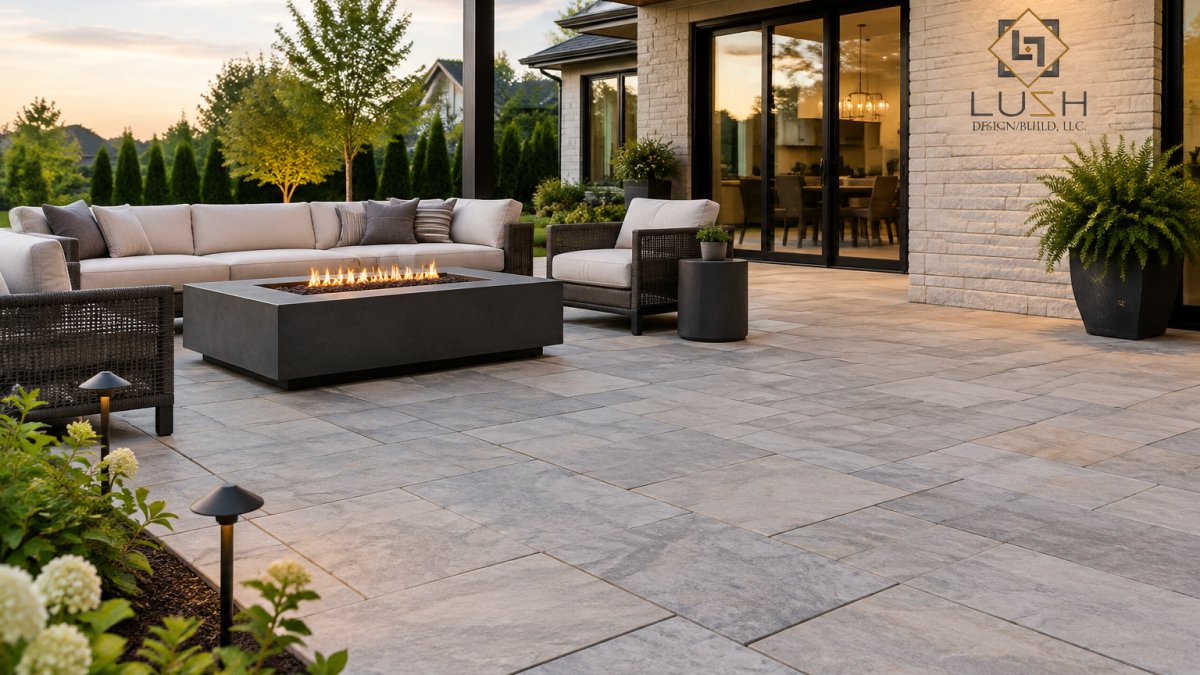
Monochromatic design is the defining trend: one stone family carried from the walkway to the patio to the pool coping, with texture doing the work that color used to.
Sloped or oddly shaped lots are not a barrier. Our guide on custom patio design for sloped yards covers how to plan a patio that handles grade without looking engineered.
Long-Term Value, Sustainability, and Smart Outdoor Integration
Long-term value comes from three things buyers notice at resale: a surface that still looks new, drainage that works, and a space that's genuinely usable. Premium paving supports curb appeal and outdoor luxury, but only when it's installed to last. The sections below cover the ownership economics, the sustainability mechanics, and the smart-integration planning that most material guides skip.
The Ownership-Cost Curve: Where the Money Actually Goes
Initial material cost is the smallest part of the story.
A common pattern is that a lower-cost surface with a demanding maintenance schedule overtakes a higher-cost surface with a light schedule within the first decade.
Watch out: a bid that quotes only the surface and installation, with no line for sealing, joint refresh, or drainage maintenance, is not a ten-year number. Ask for the maintenance schedule in writing before comparing proposals.
Sustainability That Holds Up to Scrutiny
Sustainability in paving is mostly about three levers: transport distance, permeability, and longevity. Permeable joint systems and open-graded base layers let water recharge the soil instead of running off, which also reduces load on storm drainage. And the most sustainable surface is the one you don't replace, so durability is itself an environmental argument.
Manufacturers increasingly publish environmental product declarations for their products, which let you compare embodied impact on a like-for-like basis. Ask for them when specifying.
Planning for Smart Outdoor Integration Before the Base Goes In
Smart integration is the quiet upgrade, and it is far easier to plan before the base goes in than after. The decisions that matter most are the ones buried under the surface:
- Low-voltage lighting: conduit and transformer locations need to be set before paving, not chased through finished joints.
- Outdoor kitchen and heating circuits: dedicated electrical runs and gas lines should be stubbed during base construction.
- Drainage and irrigation: permeable joints, channel drains, and drip lines interact; coordinate them in one plan.
- Heated walkway zones: embedded heating elements require a specific base assembly and a dedicated circuit.
Wire for these during construction and the patio serves you year-round. If you're weighing whether premium paving pays back, our breakdown of whether a custom patio adds home value covers resale appeal and material ROI.
Choosing a Contractor for High-End Patio Paving
Choosing a contractor is where most high-end projects succeed or fail. The material is a commodity; the installation is not. Ask how they build the sub-base, how they handle drainage, and how they protect edges and joints.
A few questions separate the serious bids from the rest:
- Can you show the sub-base and drainage detail in writing?
- How do you handle freeze-thaw movement and joint stabilization?
- What's your process for sealing and long-term maintenance?
- Who manages the schedule, and how are change orders documented?
- Can you walk me through a completed project similar to mine?
For a structured process, our guide on hiring a design-build landscape architect lays out the seven steps, key questions, and a proposal checklist. If you're comparing local firms, see how to choose custom patio builders before you sign.
Planning Your Patio Paving Project With Lush Design Build
The best patio paving starts with a plan, not a purchase order. Decide how you'll use the space, how water will move across it, and how the material will meet the house. Then specify the surface to match.
At Lush Design Build LLC, we handle that sequence for homeowners across Carmel, Fishers, Westfield, Noblesville, and the north side of Indianapolis.
Get a project estimate from Lush Design Build LLC and start planning a patio built to look right for years to come.
Frequently Asked Questions
What are the most durable paving materials for luxury patios?
Porcelain pavers, granite, and bluestone rank among the most durable choices for a high-end patio. Porcelain resists staining, fading, and freeze-thaw movement, while granite and bluestone handle heavy foot traffic and harsh weather. Slate offers strong wear resistance but can flake if it is not rated for exterior use. Durability depends as much on sub-base preparation and proper drainage as on the material itself, so the installation method matters as much as the slab you pick.
Is porcelain or natural stone better for a modern patio design?
Porcelain vs natural stone pavers comes down to the look you want and how much upkeep you will accept. Porcelain gives you consistent color, tight joints, and a stain-resistant surface that suits clean-lined contemporary architecture. Natural stone such as travertine or bluestone offers unique veining and a warmer, organic feel, but it needs sealing and more frequent cleaning. For a minimalist aesthetic with low maintenance, porcelain often wins; for one-of-a-kind character, natural stone does.
How do I choose patio paving that complements contemporary home architecture?
Start with the colors and lines of your house. A modern home with large windows and monochromatic design usually pairs well with large-format slabs, tight joints, and a restrained palette of grays, charcoals, or warm neutrals. Geometric patterns and clean lines reinforce contemporary architecture, while busy patterns can clash with it. Bring a sample board to your home and view it in daylight against your siding and trim before committing.
Can premium patio paving increase the resale value of a luxury home?
A well-designed patio with quality paving can add measurable appeal at resale because buyers see an outdoor living space that is ready to use. The return depends on design quality, installation, and how well the patio fits the home. A poorly drained or mismatched patio can hurt impressions, while a cohesive hardscape design that ties into the house often strengthens curb appeal. Talk with a design-build contractor about how the patio fits your overall property before you budget.